
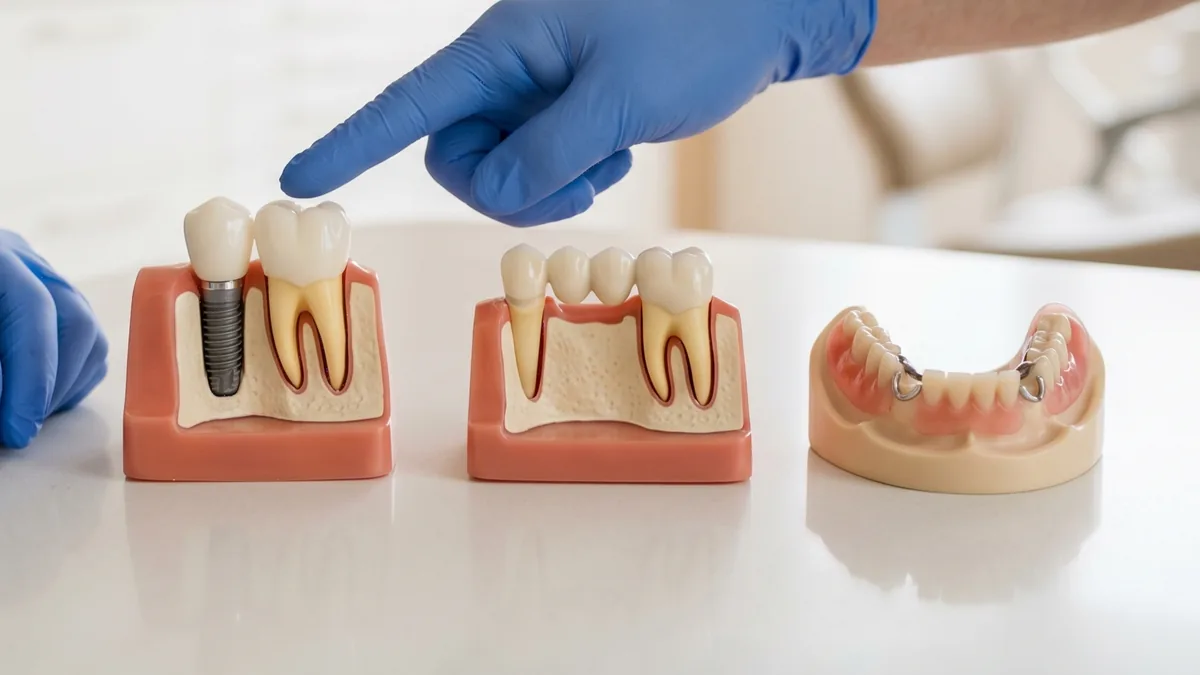
Dental Implant vs Bridge vs Denture: Which Option Is Right?
A missing tooth is not only a cosmetic issue. It can change chewing, speech, bite balance, and the position of neighbouring teeth. Patients in Gurugram usually hear three main replacement options: dental implant, bridge, or denture. Each can be right in the correct case, and each has limitations.
At Marwaha Dental Clinic, tooth replacement planning considers the number of missing teeth, bone condition, gum health, adjacent teeth, medical history, budget, and the patient's preference for fixed or removable teeth. This guide explains the differences before you discuss a personalised plan.
Quick Comparison
| Option | How It Works | Best Suited For | Main Limitation |
|---|---|---|---|
| Dental implant | Titanium root placed in jawbone, restored with crown or prosthesis | Single, multiple, or full arch tooth replacement where bone and health allow | Requires surgery and healing time |
| Bridge | Missing tooth replaced by a fixed prosthesis supported by adjacent teeth | Some single-tooth gaps when neighbouring teeth already need crowns | Adjacent teeth may need preparation |
| Denture | Removable appliance replacing missing teeth | One or more missing teeth when a removable option fits the patient's needs and preferences | Removed for cleaning; fit may need adjustment as the mouth changes |
Dental Implants: Support Without Preparing Neighbouring Teeth
A dental implant replaces the root of a missing tooth. After the implant integrates with bone, it can support a crown, bridge, or full-arch prosthesis. The implant supports remain in the jawbone and do not rely on adjacent teeth; the replacement teeth they support can be fixed or removable.
Implants may be considered for one missing tooth, several missing teeth, implant-supported dentures, or full-mouth rehabilitation. Suitability depends on bone volume, gum health, medical conditions, smoking, oral hygiene, and bite forces. Some patients need bone grafting or sinus lift before implant placement.
AAP: implant versus conventional bridge · FDA: health and surgical considerations.
Dental Bridges: Fixed Teeth Supported by Existing Teeth
A tooth-supported bridge fills a gap by using neighbouring teeth as supports. It is fixed in place and can restore appearance and function. Bridges may be sensible when the adjacent teeth already need crowns or have large restorations.
The main trade-off is that healthy adjacent teeth may need to be reshaped. A tooth-supported bridge also does not replace the tooth root, so bone in the missing tooth area can continue to shrink over time. Good hygiene under the bridge helps reduce decay and gum problems around the supporting teeth. Conventional preparation can also affect the nerve inside a supporting tooth, sometimes leading to root canal treatment. Leeds Teaching Hospitals: supporting-tooth risks and bridge care.
For one missing front tooth, compare fixed and removable choices
A visible gap can be replaced with an implant crown, a suitable tooth-supported bridge or a removable partial denture. Ask about the intended appearance, speech, bite, gum contour and temporary tooth while treatment is staged. A removable tooth can be a temporary or continuing option; it is not restricted to people missing many teeth. NHS: partial dentures replace one or more teeth · AAP: single-tooth implant and crown.
A resin-bonded bridge is another design to ask about where suitable: a wing bonded behind a neighbouring tooth supports the replacement, often with little or no drilling. It can come unstuck and is not suitable for every gap or supporting tooth. Compare it with the greater preparation of a conventional crown-retained bridge; ask which designs can be provided or arranged for your case. Leeds Teaching Hospitals: conventional and adhesive bridges.
Dentures: Removable Replacement for Missing Teeth
Dentures replace missing teeth using a removable appliance. They can be partial or complete, flexible or acrylic, conventional or implant-supported. A conventional removable denture avoids implant surgery, but fitting and adjustment take their own appointments. It may need adjustment as gums and bone change over time. NHS: denture fitting and changing fit.
For many patients, dentures and prosthodontic options are practical, especially when surgery is not preferred or not suitable. Implant-supported dentures may offer additional stability in selected cases.
When Several Teeth Need Treatment Together
A mouth with several missing or damaged teeth may need a combined plan rather than one replacement for each gap. The dentist considers which teeth can be retained, which need restoration and where implants, bridges or dentures fit the overall plan.
At Marwaha Dental Clinic, Dr. Divya Marwaha provides full-mouth rehabilitation consultations at DLF Phase 2. Her PG Diploma in Oral Implantology and Surgery is part of her verified training.
Do several adjacent missing teeth need an implant each?
Not automatically. An implant-supported bridge connects replacement teeth on implant supports; it can replace several missing teeth without a separate implant crown for each space. The number and position of supports must be planned for the gap, bone, bite and replacement design. A count of missing teeth alone cannot choose the implant count. Ask how the proposed bridge will be cleaned and repaired, and compare separate crowns, a tooth-supported bridge or partial denture where suitable. American Academy of Periodontology: multiple-tooth implant replacement · MDC implant-supported bridge assessment.
Questions To Ask Before Choosing
- Is the gap visible when I smile or mostly functional?
- Are the neighbouring teeth healthy or already damaged?
- Do I have enough bone for implants?
- Do I want a fixed option or am I comfortable with removable teeth?
- How much maintenance will each option need?
- What happens if I leave the gap untreated?
Cost Factors Without Fixed Price Promises
The cost of tooth replacement depends on the number of teeth, implant brand, crown material, bone grafting needs, whether temporary teeth are required, and how complex the bite is. For implants, see the dental implant cost guide. A clinical examination is needed before an accurate treatment estimate can be given.
How the Location of the Missing Tooth Changes the Decision
A missing front tooth can affect smile appearance, speech, and gum contour. A missing back tooth can affect chewing strength and bite balance. A missing molar may not show when smiling, but it can still affect how forces travel through the mouth. This is why the same option is not automatically right for every gap.
For a single visible front tooth, aesthetics and gum shape become very important. For a back molar, chewing load and bone support matter heavily. For multiple missing teeth, the plan may shift toward implant-supported bridges, partial dentures, or full mouth rehabilitation rather than one isolated replacement. Cleveland Clinic: missing-tooth function and individual replacement choices.
Maintenance: The Part Patients Often Forget
Every replacement option needs maintenance. Implants need careful cleaning around the gumline and regular review. Bridges need cleaning under the false tooth and around the supporting teeth. Dentures need daily removal, cleaning, and periodic fit checks because the gums and jawbone can change shape over time.
A good choice is not only the option that looks right on day one. It is the option the patient can maintain comfortably for years, with realistic follow-up and hygiene habits.
NHS: denture cleaning and review · FDA: implant cleaning and follow-up · Cleveland Clinic: bridge maintenance.
How Different Patient Situations Change the Recommendation
| Patient Situation | Options Usually Discussed | Planning Focus |
|---|---|---|
| One missing front tooth | Implant crown, suitable bridge or removable partial denture | Smile line, gum contour, colour match, and timing. |
| One missing back tooth | Implant, bridge, or monitored gap in selected cases | Chewing load, opposing tooth movement, bone support. |
| Several missing teeth | Implant-supported bridge, partial denture, or combined plan | Number of supports, bite balance, cleanability. |
| Loose full denture | New denture, implant-supported denture, or full-mouth rehabilitation | Stability, bone volume, medical suitability, maintenance. |
| Weak adjacent teeth | Bridge, implants, crowns, or staged rehabilitation | Whether adjacent teeth need treatment anyway. |
Compare the Complete Plan, Not Just One Tooth
Ask how each option affects the surrounding teeth, what cleaning it needs and how future repairs would be handled. A fixed replacement may appeal initially, but surgery, healing, available bone and maintenance still need discussion. A removable option may be a practical choice when it matches the patient’s needs.
Explore dental implants, dentures and prosthodontics and full-mouth rehabilitation before discussing a personalised plan.
FAQs: Missing Tooth Replacement in Gurgaon/Gurugram
No. Suitability depends on the gap, neighbouring teeth, bone, gum health and preferences about surgery and maintenance. Ask how each option affects the rest of the mouth. Our implant guide explains the surgical option; a consultation should also assess non-implant alternatives.
Yes. A removable denture can be appropriate when several teeth are missing or when other options do not suit the mouth, health or budget. Fit, cleaning and review remain important. Read the denture guide to discuss design and maintenance.
No. Implant-supported teeth can be fixed or removable, depending on the design. Ask who removes them, how to clean underneath or around attachments, and what maintenance is expected. The implant-supported bridge guide covers one fixed option.
A conventional tooth-supported bridge usually involves preparing supporting teeth. An implant-supported replacement uses implants instead, but requires assessment for surgery. If neighbouring teeth already need crowns, that changes the comparison. Discuss how each proposed option affects those teeth using the single missing tooth guide.
There is no one answer for every mouth. Dentures are removed for cleaning; bridges need cleaning beneath or around the replacement teeth, and implants also need continuing care. Have the dentist demonstrate the proposed routine and consider your ability to carry it out. See denture care and fixed implant bridge care.
Book a Consultation
Marwaha Dental Clinic is at J-4/33, DLF Phase II, opposite Sahara Mall, Gurugram – 122002. Call or WhatsApp +91-9818379780. Clinic hours are Monday to Saturday, 11AM–7PM.