
Thinking About Dental Implants? Here's What to Know Before You Decide
Dental implants are the closest modern dentistry gets to replacing a lost tooth in a stable, long-term way — and unlike a bridge or denture, a well-planned implant can be a long-lasting replacement without affecting the teeth around it. But outcomes vary significantly depending on the surgeon's qualifications, the technology used, and whether your bone has been properly assessed before treatment begins. This guide is written for patients in Gurugram weighing their options: what the procedure actually involves, how to evaluate a clinic before you commit, what bone grafting means for patients who've been told they can't get implants, and what can explain cost differences between clinics.
What Is a Dental Implant and When Is It Recommended?
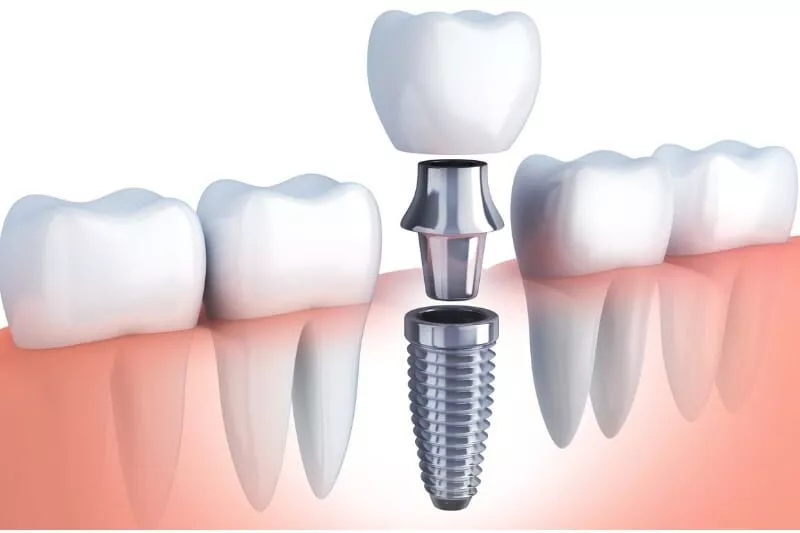
A dental implant is a small titanium screw placed into your jawbone to replace the root of a missing tooth. Over the next two to four months, the bone grows around it — a process called osseointegration — and the implant becomes as stable as a natural root. A crown is placed on top, and the result looks, feels, and is designed to restore chewing function and appearance in a natural-looking way.
The key difference between an implant and a bridge or denture is that an implant is fixed in the jaw and does not rely on adjacent teeth. With reasonable care, implants can be long-lasting. Bridges require grinding down two healthy adjacent teeth. Dentures loosen over time and affect speech and eating. For many patients with good general health and adequate bone, an implant may be a suitable long-term option.
You likely need a dental implant if you have:
- A single missing tooth in any position
- Multiple missing teeth spread across the jaw
- Complete tooth loss in the upper or lower jaw
- Loose, ill-fitting dentures that affect your daily life
- Tooth loss due to decay, fracture, gum disease, or trauma
How to Choose the Right Dental Implant Clinic in Gurugram
Not every clinic advertising dental implants in Gurugram has a qualified oral surgeon on staff. Some general dentists offer implants after short training courses. That's acceptable for uncomplicated single-tooth cases — but it's not suitable when your case involves bone loss, multiple implants, or full-mouth reconstruction. Here's what to check before you book.
1. Verify the surgeon's qualification
For complex implant surgery, an MDS in Oral & Maxillofacial Surgery is an important specialist qualification to look for. Dr. Supreet Kaur Sawhney at Marwaha Dental Clinic holds an MDS, serves as Senior Consultant at Fortis Hospital, Manipal Hospital, Holy Angel Hospital, Mayom Hospital, and Sanar International Hospital, and has clinical research published in peer-reviewed journals. These credentials should be reviewed as part of your decision-making before treatment.
2. Ask whether bone grafting is available in-house
A significant number of patients seeking dental implants in Gurugram have been told by other clinics that they don't have enough jawbone. Bone naturally resorbs after a tooth is lost — especially if it's been missing for years. Depending on the case, bone grafting, sinus lift planning, ridge augmentation, socket preservation, or zygomatic implant assessment may be considered. Learn more about bone grafting for implants in Gurugram.
3. Confirm continuity of care
Marwaha Dental Clinic has operated in Gurugram since 2004 as a doctor-led practice. Implant surgery is planned with Dr. Supreet, while cosmetic and restorative work is led by Dr. Divya Marwaha (Gold Medalist, Ex-AIIMS, 25+ years). This structure helps patients receive continuity of care across consultation, treatment planning, surgery, restoration, and follow-up.
4. Read genuine Google reviews
Before choosing treatment, patients should read current Google and Practo reviews directly and discuss expectations during consultation. Public review platforms can help patients understand the clinic experience across implants, root canals, cosmetic dentistry, and oral surgery.
5. Confirm location convenience
Two clinics — J-4/33, DLF Phase 2 opposite Sahara Mall, and 395 P, Sector 39 near Medanta Hospital — give patients from Golf Course Road, Golf Course Extension Road, Sushant Lok, and Sectors 38–45 easy access to a senior specialist. Patients near Medanta Hospital Gurugram will find the Sector 39 clinic the convenient dental implant clinic option in the area. Patients in DLF Phase 2 are covered at the DLF Phase 2 clinic opposite Sahara Mall.
Types of Dental Implants at Marwaha Dental Clinic, Gurugram
| Implant Type | Usually Considered For | Approximate Timeline |
|---|---|---|
| Single Tooth Implant | One missing tooth | 3–6 months |
| Multiple Tooth Implants | Several gaps across the jaw | 3–6 months |
| Full Mouth Rehabilitation | Complete tooth loss | May be possible in selected suitable cases |
| Immediate Implant Placement | Implant placement after extraction when clinically suitable | Case-dependent |
| Implant-Supported Dentures | Loose or unstable dentures | 3–6 months |
| Zygomatic Implants | Severe bone loss cases | Specialist assessment |
When Bone Is Not Enough: What Happens Next
"The dentist told me I don't have enough bone for implants." Dr. Supreet Kaur Sawhney hears this regularly from patients referred from other Gurugram clinics. It doesn't have to be the end of the story. With suitable assessment and bone grafting where indicated, many patients can explore implant treatment options.
Procedures available at Marwaha Dental Clinic, Sector 39, near Medanta Hospital:
- Ridge Augmentation — rebuilds the width and height of a shrunken jawbone to create a stable implant site
- Sinus Lift — adds bone below the sinus floor for upper jaw implants where vertical height is insufficient
- Socket Preservation — fills the extraction gap immediately after extraction to prevent bone shrinkage
- Zygomatic Implants — for severe upper jaw bone loss, the implant anchors in the cheekbone, bypassing the need for large-scale grafting entirely
Patients who arrive with a history of difficult implant consultations elsewhere can receive a clear treatment discussion after assessment at our Sector 39 clinic, near Medanta.
What to Expect: The Implant Surgery, Step by Step
This is a common concern for patients before booking. Implant surgery is performed under local anaesthesia. You should feel pressure rather than sharp pain, and comfort is monitored throughout.
- A digital X-ray and 3D CBCT scan to map your jawbone precisely
- Local anaesthesia — you may feel pressure, and comfort is monitored throughout
- A small incision in the gum to expose the bone
- The titanium implant is placed precisely into the jawbone
- The gum is sutured — the whole procedure takes 45–90 minutes
- You usually go home after the procedure with post-operative instructions; return to routine work depends on the case and your surgeon's advice
After 2–4 months of healing (while bone fuses with the implant), you return for crown placement. Post-surgical discomfort varies by patient and case complexity, and follow-up care is planned accordingly. The clinic's laser technology may help reduce tissue trauma in selected cases compared with conventional techniques.
Dental Implant Cost in Gurugram: What You're Actually Paying For
Implant costs in Gurugram vary widely depending on implant brand, surgeon qualification, technology used, bone-grafting needs, and what is included in post-surgical care. The clinic team can explain anticipated charges after examining your case.
At Marwaha Dental Clinic, you receive:
- An MDS Oral Surgeon planning and performing implant surgery
- 20+ years of implant surgery experience, including complex reconstructive cases
- Full in-house capability for bone grafting, sinus lifts, and zygomatic implants
- Digital X-ray and 3D CBCT scanning before surgery to support careful planning
- Post-surgical follow-up at either DLF Phase 2 or Sector 39, Gurugram
- A 22-year practice built on continuity of care and long-term patient relationships
A failed implant that requires removal and revision can be more complex and expensive than careful planning from the start. Choosing a qualified oral surgeon in Gurugram for complex cases can reduce risk and support better treatment planning.
Frequently Asked Questions — Dental Implants in Gurugram
Which implant surgeon in Gurugram can I consult?
Dr. Supreet Kaur Sawhney at Marwaha Dental Clinic — MDS Oral & Maxillofacial Surgeon, Senior Consultant, 20+ years of implant surgery experience. She practices at DLF Phase 2 opposite Sahara Mall and Sector 39 near Medanta Hospital, Gurugram.
Can I get dental implants if I have been told I have bone loss?
Yes. Dr. Supreet Kaur Sawhney specialises in bone grafting, ridge augmentation, sinus lifts, and zygomatic implants — all designed for patients with insufficient jawbone. An assessment at Marwaha Dental Clinic Sector 39 will confirm which approach your case needs.
How long does full mouth rehabilitation take in Gurugram?
At Marwaha Dental Clinic, shorter full-mouth rehabilitation protocols may be possible in selected suitable cases. The exact timeline depends on bone condition, the number of implants required, and clinical assessment.
Is there a dental implant clinic near Medanta Hospital, Gurugram?
Yes. Marwaha Dental Clinic Sector 39 is at 395 P, Sector 39, Gurugram — near Medanta Hospital. Full implant services by Senior Consultant Dr. Supreet Kaur Sawhney. Call +91-9650298009.
Which dental clinic in DLF Phase 2 Gurugram does dental implants?
Marwaha Dental Clinic at J-4/33, DLF Phase 2 opposite Sahara Mall, Gurugram — operating since 2004. Dr. Supreet Kaur Sawhney handles implant surgery. Dr. Divya Marwaha (Gold Medalist, Ex-AIIMS, 25+ years) handles cosmetic and restorative dentistry. Call +91-9818379780.
Book An Appointment
Message the clinic on WhatsApp during clinic hours
Book via WhatsAppTimings: Mon-Sat: 10AM-8PM