
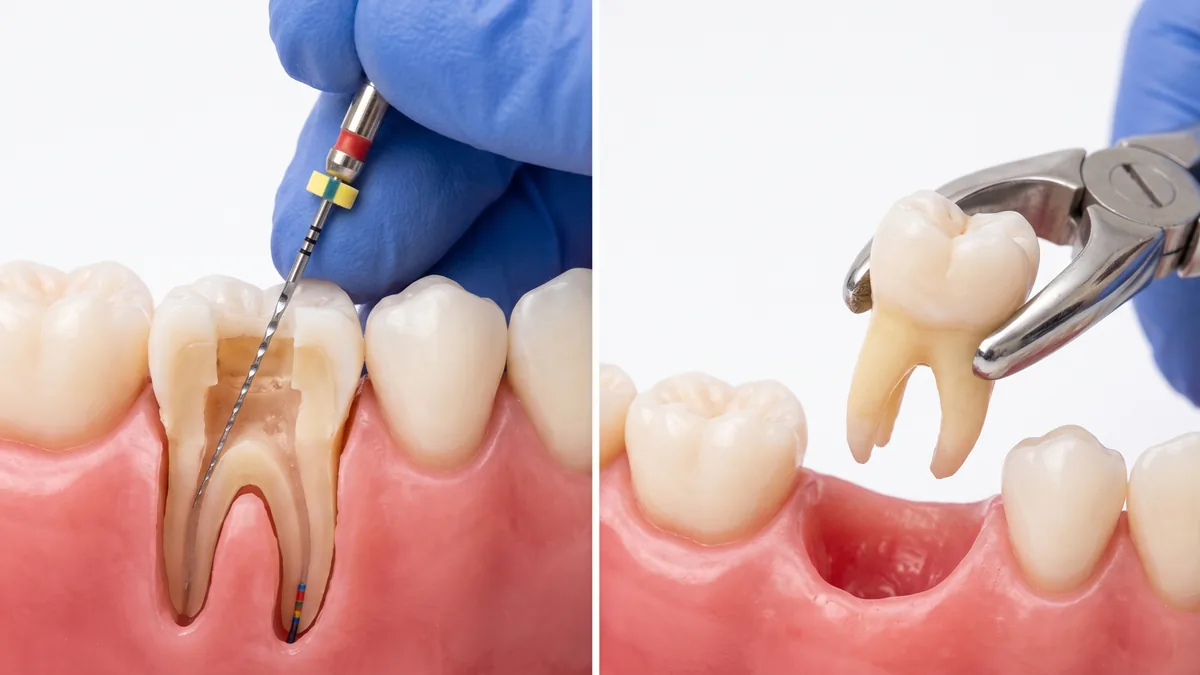
Root Canal vs Tooth Extraction: Which Is Better for an Infected Tooth?
When a tooth is badly infected or painful, many patients in Gurgaon and Gurugram ask for the fastest way to stop the pain. Some arrive expecting an extraction. Others are worried that a root canal will be complicated. The right answer depends on the tooth, the infection, the amount of remaining tooth structure, your bite, your gum and bone support, and your long-term replacement options if the tooth is removed.
For a restorable tooth, root canal treatment may preserve it. When retention is unsuitable, extraction and any replacement can be discussed at Marwaha Dental Clinic in DLF Phase 2, Gurugram. The diagnosis and remaining tooth structure and support guide the choice.
When an infected tooth needs urgent or emergency care
A suspected dental abscess needs urgent dental assessment and does not reliably resolve without treatment. This is different from ordinary soreness after treatment. If a dental infection causes difficulty breathing, speaking or swallowing, major swelling in the mouth, eye swelling or pain, sudden vision changes, or difficulty opening the mouth, seek local emergency medical care immediately. Do not wait for a dental appointment or a clinic message reply. NHS dental abscess advice.
Quick Answer: Root Canal or Extraction?
| Situation | Usually Considered | Why |
|---|---|---|
| Diagnosed pulp disease in a tooth that can be restored | Root canal treatment and an appropriate final restoration | The natural tooth may be retained when the diagnosis, remaining structure and support allow it. |
| Infected pulp with restorable roots | Root canal treatment | The infected tissue can be removed while preserving the tooth root. |
| Vertical root fracture | Extraction or removal of the affected root | The possible option needs tooth-specific assessment; the whole tooth is not always removed. |
| Severe bone loss around the tooth | Extraction may be needed | The tooth may not have enough support even after infection control. |
| Tooth broken far below the gum | Case-dependent | X-ray and examination decide whether restoration is possible. |
What Root Canal Treatment Actually Does
A root canal does not remove the tooth. It removes infected or inflamed pulp from inside the tooth. The canals are cleaned, shaped, disinfected, filled, and sealed. In many back teeth, a crown is then recommended to protect the remaining tooth structure from fracture during chewing. AAE: root-canal treatment and final restoration.
MDC’s published equipment information describes a rotary endodontic system. Laser-assisted root canal treatment is an adjunct whose suitability depends on the diagnosis and technique, rather than a required step for every tooth. Local anaesthesia is usually used. Selected straightforward cases may suit one visit, while other teeth need staged care; the final restoration may require a separate appointment.
What Extraction Actually Means
Extraction removes the tooth completely. It may be the correct treatment when a tooth is split, has severe gum and bone loss, is unrestorable, or is causing repeated infection that cannot be controlled predictably. But extraction also creates a new decision: what will replace the missing tooth?
Leaving a gap may affect chewing, and remaining teeth may shift. Depending on the location, replacement may involve a bridge, removable denture, or dental implant. That is why extraction should not be viewed as only a one-step procedure. It is often the start of a replacement plan. ADA: missing teeth and replacement options.
Why Saving a Natural Tooth Is Often Preferred
When a tooth can be saved predictably, root canal treatment may preserve function without needing a prosthetic replacement.
- It keeps your own tooth in place.
- It avoids an immediate replacement decision.
- It can restore comfortable chewing when followed by the right restoration.
- It protects neighbouring teeth from unnecessary preparation for a bridge.
AAE: tooth function and restoration.
When Extraction May Be the Better Decision
A tooth-by-tooth assessment is needed before choosing preservation or extraction. A fracture, mobility or reduced support should be investigated rather than treated as an automatic reason to remove the tooth. Ask whether a durable restoration is feasible and how its expected outlook compares with extraction and replacement.
A severe fracture, inadequate support or a tooth that cannot be restored may prevent retention. A vertical root fracture often needs extraction or removal of the affected root; the option requires tooth-specific assessment. See the AAE guide to cracked teeth. Examination and X-ray findings guide the decision rather than symptoms alone.
Can antibiotics cure the infection without treating the tooth?
Antibiotics do not replace treatment of an infected tooth’s source. For adults with normally functioning immune systems, the ADA antibiotic guideline prioritises dental procedures for the specified pulp and root-tip conditions. Antibiotics are generally unnecessary for those localized conditions when definitive treatment is available. They may be prescribed alongside urgent care when an abscess causes fever or feeling generally unwell, or for selected abscesses when immediate dental treatment is unavailable. People with impaired immunity need individual advice outside that guideline’s scope. Tell the dentist about your health and medicines; do not delay the recommended dental procedure because symptoms improve.
A large area is visible around the root: can the tooth still be saved?
It may still be possible, but the size of the finding alone cannot decide. An X-ray finding must be interpreted with examination and clinical tests; the image cannot supply every part of the diagnosis. Ask what the area represents and how it affects the treatment outlook. ADA: interpreting dental X-rays · Cleveland Clinic: tooth-root views.
The separate question is whether the tooth can be treated and then restored into useful function. Remaining sound structure, root damage and gum-and-bone support still matter. A large-looking area does not by itself prove extraction is required, and a small-looking area does not prove the tooth can be saved. The dentist needs to explain the diagnosis, proposed treatment, uncertainties and follow-up rather than predict success from size alone. AAE: assessing whether a tooth can be treated.
Should a damaged natural tooth be saved before considering an implant?
Ask whether the natural tooth has a reasonable treatment and restoration plan before deciding to remove it. The decision combines its remaining structure, gum support, root-canal outlook and usefulness in your bite with your preferences and ability to maintain it. AAE: restorability and patient considerations.
Neither keeping the tooth at any cost nor choosing an implant automatically is a sound rule. If retention is unsuitable, discuss the complete extraction and replacement plan. An implant is a replacement option requiring its own assessment; the existing tooth’s poor outlook does not establish implant suitability. See single-tooth implant planning and implant, bridge and denture options.
Cost: Why the Cheaper First Step Is Not Always Cheaper Overall
Patients often compare the cost of root canal treatment with the cost of extraction. That comparison is incomplete. Root canal treatment may also need a crown. Extraction may later need a bridge, implant, or denture. The total cost depends on the full treatment pathway, not only the first appointment.
For a detailed explanation of what affects RCT fees, see the root canal cost guide. If extraction and replacement are being considered, discuss implant, bridge, and denture options before deciding.
How Marwaha Dental Clinic Decides
Dr. Divya Marwaha explains the realistic options before treatment. If root canal treatment is suitable, the goal is to save the tooth in a way that is stable. If extraction is the safer option, replacement planning can be discussed so the gap does not become a long-term problem.
How Symptoms Guide the Urgency of Treatment
A dull ache, sharp biting pain, swelling, or night pain can point to different dental problems. Lingering sensitivity to hot or cold often suggests deeper pulp inflammation. Pain on biting may suggest a crack, or infection around the root. Swelling or a gum boil can accompany infection and needs dental assessment. AAE: root-canal symptoms and assessment.
Symptoms alone are not enough to decide between root canal and extraction. A tooth can be very painful but still saveable. Another tooth may cause only mild discomfort but have a fracture that makes long-term restoration unreliable. That is why clinical examination and X-rays matter.
What Happens During the Consultation
During a consultation, the dentist checks the tooth, surrounding gums, bite, mobility, and X-ray findings. The key question is not only whether the infection can be cleaned, but whether the remaining tooth can be sealed and restored strongly afterward. A root canal without a stable final restoration can fail because bacteria may re-enter or the tooth may crack.
Patients should ask three practical questions: can this tooth be saved predictably, will it need a crown, and what is the replacement plan if it cannot be saved? Clear answers to these questions make the decision less emotional and more clinical.
Clinical Factors That Make the Decision Clearer
The root canal versus extraction decision is not made from pain level alone. A very painful tooth may still be saveable, while a mildly uncomfortable tooth may have a fracture or gum support problem that makes long-term restoration unreliable. The dentist has to judge both the infection and the future strength of the tooth.
| Clinical Check | Why It Matters | Question To Ask |
|---|---|---|
| Remaining tooth structure | A root canal needs enough tooth left to seal and restore with a filling or crown. | Will this tooth be strong after the final restoration? |
| Root fracture signs | A vertical root fracture can make saving the tooth unpredictable. | Is there any sign of a crack extending into the root? |
| Gum and bone support | A tooth with poor periodontal support may stay mobile even after infection control. | Is the surrounding bone support healthy enough? |
| Bite load | Back teeth and patients who grind may need stronger protection after RCT. | Will I need a crown or bite protection? |
| Replacement plan | If extraction is chosen, the gap should be planned before the tooth is removed. | What happens after extraction: implant, bridge, denture, or no replacement? |
AAE: restorability · Leeds Teaching Hospitals: crown suitability.
Why This Decision Matters Long Term
A root canal is not successful only because pain stops. It must also be sealed well, restored well, and reviewed if symptoms return. Similarly, an extraction is not complete planning if the missing tooth will affect chewing, adjacent tooth movement, or future implant options. The most useful consultation is one where the dentist explains the full path, not only the first procedure.
FAQs: Root Canal vs Extraction in Gurugram
Neither option is right for every tooth. The decision depends on the diagnosis, remaining structure, gum support and whether a useful restoration is feasible. A crack or mobility needs assessment; it does not by itself prove extraction is best. Compare root canal treatment with the consequences of removing and replacing that tooth.
A suspected dental abscess needs urgent dental assessment and does not reliably resolve without treatment. Pain relief or a change in symptoms does not establish that the source has been treated. If a dental infection causes difficulty breathing, speaking or swallowing, major swelling in the mouth, eye swelling or pain, sudden vision changes, or difficulty opening the mouth, seek local emergency medical care immediately. Do not wait for a dental appointment. The dentist will decide which dental procedure is appropriate after assessment. See NHS dental abscess advice and the urgent dental care guide.
For tooth preservation, compare the canal treatment and final restoration. For extraction, discuss whether replacement is needed and include that plan in the comparison. See the root canal cost guide and tooth replacement options. The cheapest first appointment may not represent the complete plan.
Antibiotics do not by themselves restore a damaged tooth or remove every source of dental infection. An abscess needs urgent dental care, which may include drainage and treatment of the affected tooth. The dentist decides whether antibiotics are also needed. See NHS dental abscess guidance.
Immediate placement is a separate assessment, not an automatic step after extraction. The site, supporting tissues and proposed restoration determine whether it is appropriate or whether healing should come first. The single-tooth implant guide explains extraction, implant placement and temporary-tooth timing.
Book a Consultation
Marwaha Dental Clinic is at J-4/33, DLF Phase II, opposite Sahara Mall, Gurugram – 122002. Call or WhatsApp +91-9818379780. Clinic hours are Monday to Saturday, 11AM–7PM.