
Wisdom Tooth Removal in Gurugram: When to See an Oral Surgeon
Most people find out they have wisdom teeth the wrong way — a dull ache at the back of the jaw, a swollen gum, or an X-ray at a routine check-up that reveals something their dentist wants to discuss. The immediate question is always the same: does it need to come out? The honest answer is: not always. But when it does, timing matters more than most patients realise. Dr. Supreet Kaur Sawhney — MDS Oral & Maxillofacial Surgeon and Senior Consultant — has performed hundreds of wisdom tooth extractions and assessments at Marwaha Dental Clinic. This guide covers what wisdom teeth are, when they become a genuine problem, and what the procedure involves for patients in Gurugram.
What Are Wisdom Teeth?
Wisdom teeth are your third molars — the last set of permanent teeth to erupt, typically appearing between the ages of 17 and 25. Most adults have four wisdom teeth, one in each corner of the mouth. Some people have fewer. Some never develop them at all. And some have wisdom teeth that erupt completely, sit straight, and cause no problems whatsoever for their entire lives.
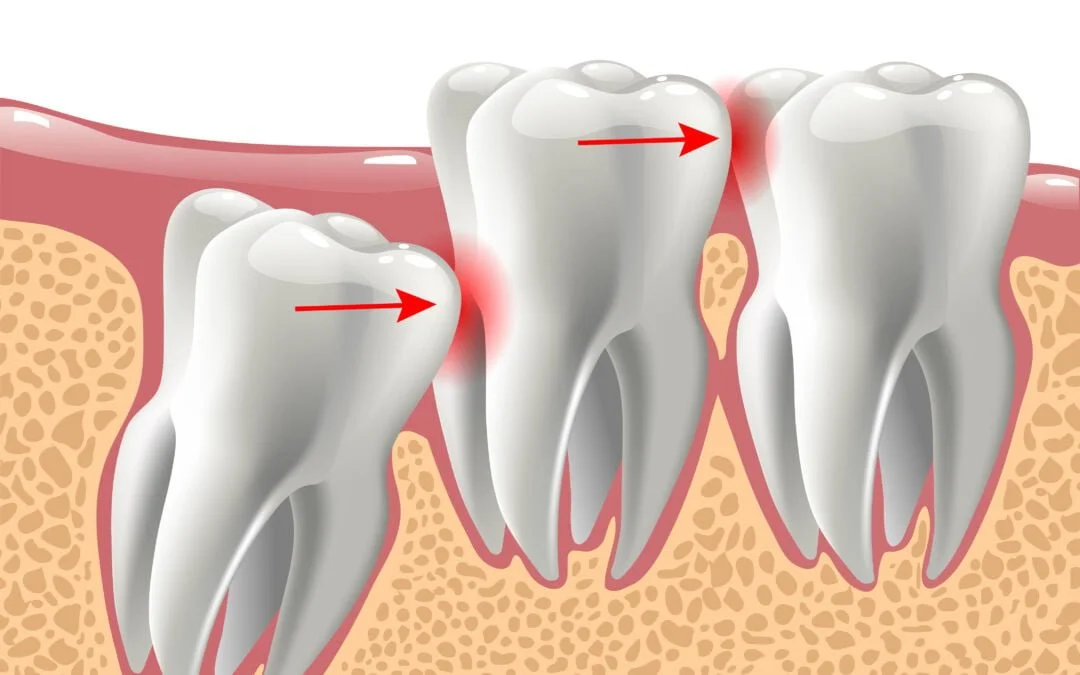
The issue is that the human jaw has, over thousands of years of evolution, become smaller — while the number of teeth has stayed the same. Wisdom teeth frequently run out of room. When there isn't enough space for them to erupt fully and correctly, they become what's called impacted — partially or fully trapped beneath the gum or bone, growing at angles that cause problems for the teeth around them.
When Does a Wisdom Tooth Need Attention?
Not every wisdom tooth needs to be removed. A wisdom tooth that has erupted fully, sits straight, can be cleaned properly with a toothbrush, and isn't affecting neighbouring teeth is generally left alone. The decision to extract is based on clinical and radiographic evidence — not just the presence of the tooth.
These are the situations where extraction may be clinically recommended:
- Impaction — the tooth is trapped under the gum or bone, partially or fully, and cannot erupt into a functional position
- Pericoronitis — recurring infection of the gum flap over a partially erupted wisdom tooth; the flap traps food and bacteria, leading to pain, swelling, and sometimes fever
- Decay in the wisdom tooth or the molar in front of it — a partially erupted wisdom tooth creates a cleaning trap; both the wisdom tooth and the second molar behind it are vulnerable to cavities that are difficult or impossible to restore
- Pressure and crowding — a wisdom tooth pushing against the second molar can cause damage to that tooth's root, or contribute to crowding of the front teeth over time
- Cyst formation — an impacted wisdom tooth can develop a cyst around it in the jawbone; left untreated, cysts can expand and cause significant bone damage
- Pain or swelling with no other cause — not all wisdom tooth pain is constant, but recurring episodes are a reliable sign that the tooth will become a bigger problem if left
The most important thing is an accurate diagnosis — a digital X-ray or OPG (panoramic X-ray) that shows the position of the tooth, its roots, its proximity to adjacent teeth, and its relationship to the inferior alveolar nerve in the lower jaw. Dr. Supreet Kaur Sawhney assesses each case individually; no extraction is recommended without clear radiographic justification.
Types of Wisdom Tooth Impaction
Understanding how a wisdom tooth is positioned helps explain why some cases are straightforward and others require a specialist oral surgeon rather than a general dentist.
| Impaction Type | What It Means | Complexity |
|---|---|---|
| Soft tissue impaction | Crown has erupted through bone but gum covers part of it | Straightforward |
| Partial bony impaction | Tooth is partly covered by jawbone | Moderate |
| Full bony impaction | Tooth is completely enclosed in jawbone | Requires specialist |
| Horizontal impaction | Tooth is lying on its side, pushing into adjacent molar | Requires specialist |
| Mesioangular impaction | Tooth is angled forward toward the second molar | Moderate to complex |
Fully impacted and horizontally positioned wisdom teeth may require surgical extraction - a procedure that involves making a small incision in the gum, removing bone around the tooth if necessary, and sometimes sectioning the tooth before removal. This is an oral surgery procedure, not a simple extraction, and complex cases should be assessed by a qualified oral surgeon. Dr. Supreet Kaur Sawhney holds an MDS in Oral & Maxillofacial Surgery, a specialist qualification relevant to complex wisdom tooth cases.
What Does the Procedure Involve?
The procedure varies based on the tooth's position, but here is what a wisdom tooth extraction at Marwaha Dental Clinic typically involves:
- Digital X-ray or OPG — to precisely map the tooth's position, root anatomy, and proximity to the nerve before any treatment begins
- Local anaesthesia - the area is numbed carefully. Patients may feel pressure or movement during the procedure, while sharp pain should be minimised
- Gum incision (surgical cases) — a small cut in the gum exposes the tooth and surgical area
- Bone management if needed — for fully impacted teeth, a small amount of bone surrounding the tooth is carefully removed
- Tooth sectioning if needed — complex cases involve dividing the tooth into sections for controlled removal
- Extraction — the tooth or sections are removed; the socket is cleaned thoroughly
- Suturing — dissolvable stitches close the site; these dissolve on their own within 7–10 days
- Post-procedure discharge — patients go home after the procedure with post-operative instructions and medication
Most wisdom tooth extractions take between 20 and 60 minutes depending on complexity. Local anaesthesia is used to minimise pain during the procedure, although patients may still notice pressure and movement. Understanding this difference often helps reduce anxiety before treatment.
Recovery: What to Expect After Wisdom Tooth Removal
Recovery after wisdom tooth extraction is usually manageable when the procedure is planned carefully and aftercare instructions are followed. Here is an honest picture of the first week:
- Day 1: Bleeding is normal for the first few hours. Bite down on a gauze pad, avoid rinsing, and rest. Soft foods only. Keep your head elevated.
- Days 2–3: Swelling peaks around 48 hours. This is expected — it's the body's healing response. Cold compresses on the outside of the jaw help. Discomfort is manageable with prescribed medication.
- Days 4–5: Swelling begins to reduce. Many patients return to desk work by day 3 or 4, depending on the complexity of the extraction and their recovery. Avoid hard or crunchy food.
- Day 7: Many patients are largely back to normal. Sutures dissolve around this time. A follow-up is scheduled at Marwaha Dental Clinic to confirm healing.
The one complication to know about: dry socket. This occurs when the blood clot in the extraction socket is dislodged before the site has healed — exposing the bone beneath. It causes a distinct, deep ache starting 3–4 days after extraction. It can usually be treated at the clinic. Dry socket risk is higher in smokers and in patients who rinse aggressively or use straws in the first 24 hours. Following post-operative instructions carefully is an important prevention step.
Why Timing Matters: The Case for Early Assessment
Wisdom tooth problems do not always resolve on their own. A partially erupted tooth that causes one episode of pain may cause recurring symptoms. In some cases, the longer an impacted tooth remains, the more complex extraction can become as roots mature and sit closer to important structures. Early assessment can make planning simpler.
The ideal time for a wisdom tooth assessment is before problems begin — at a routine check-up in your early twenties. An OPG X-ray shows how the teeth are developing, and Dr. Supreet Kaur Sawhney can advise whether to monitor, plan early removal, or leave well alone. This is proactive dentistry, and it avoids the scenario most patients dread: emergency extraction during an acute infection, when swelling complicates anaesthesia and recovery is harder.
Why Choose an Oral Surgeon for Wisdom Tooth Removal in Gurugram?
General dentists can perform simple wisdom tooth extractions — and for straightforward, fully erupted teeth, this is appropriate. But for impacted cases, particularly those involving full bony impaction, horizontal positioning, or proximity to the inferior alveolar nerve, the procedure requires an MDS-qualified oral and maxillofacial surgeon.
The risks associated with complex extractions can include nerve injury causing temporary or permanent numbness of the lip and chin, damage to adjacent teeth, incomplete removal leading to infection, and jaw fracture in severe cases. These risks are one reason complex wisdom tooth cases should be assessed carefully before treatment.
At Marwaha Dental Clinic, you receive an MDS Oral & Maxillofacial Surgeon with 20+ years of surgical experience, Senior Consultant credentials at Fortis Hospital, Manipal Hospital, Holy Angel Hospital, Mayom Hospital, and Sanar International Hospital, and published clinical research — at a private clinic with 22 years of clinical presence in Gurugram.
Frequently Asked Questions — Wisdom Tooth Removal in Gurugram
How do I know if my wisdom tooth needs to be removed?
Pain, swelling, recurring infection, or decay near the back of your jaw are all reasons to get assessed. The only reliable way to know is a clinical examination and X-ray. Book an assessment at Marwaha Dental Clinic — Dr. Supreet Kaur Sawhney will tell you clearly whether extraction is necessary, optional, or unnecessary for your specific case.
Is wisdom tooth removal painful?
The procedure is performed under effective local anaesthesia. Patients may feel pressure or movement, while sharp pain should be minimised. Post-operative discomfort is expected for 2-4 days and is managed with prescribed medication. The level of discomfort is directly related to the complexity of the case; a simple erupted tooth has a far easier recovery than a fully impacted surgical extraction.
Can all four wisdom teeth be removed at once?
In some cases, yes — particularly if all four are straightforward erupted teeth. For surgical cases, Dr. Supreet Kaur Sawhney typically recommends removing one side at a time so patients can eat and function on the other side during recovery. The decision is made based on each patient's specific anatomy and overall health.
How long is recovery after wisdom tooth removal?
Most patients return to desk work within 2–4 days. Swelling peaks at 48 hours and resolves over the following days. Full healing of the socket takes several weeks, but this occurs without symptoms. Patients are seen for a follow-up at Marwaha Dental Clinic around day 7 to confirm healing.
Which oral surgeon can I consult for wisdom tooth removal in Gurugram?
Dr. Supreet Kaur Sawhney at Marwaha Dental Clinic — MDS Oral & Maxillofacial Surgeon, Senior Consultant, 20+ years of surgical experience. She practices at DLF Phase 2 (opposite Sahara Mall) and Sector 39 (near Medanta Hospital), Gurugram.
Is there a risk of nerve damage during wisdom tooth removal?
For lower wisdom teeth positioned close to the inferior alveolar nerve, nerve proximity is assessed on X-ray before surgery. In cases where the root is very close to the nerve, Dr. Supreet Kaur Sawhney may recommend a CBCT scan for precise 3D mapping. Careful imaging and specialist assessment can help reduce risk, which is why qualifications matter for complex cases.
Book An Appointment
Message the clinic on WhatsApp during clinic hours
Book via WhatsAppTimings: Mon-Sat: 10AM-8PM