
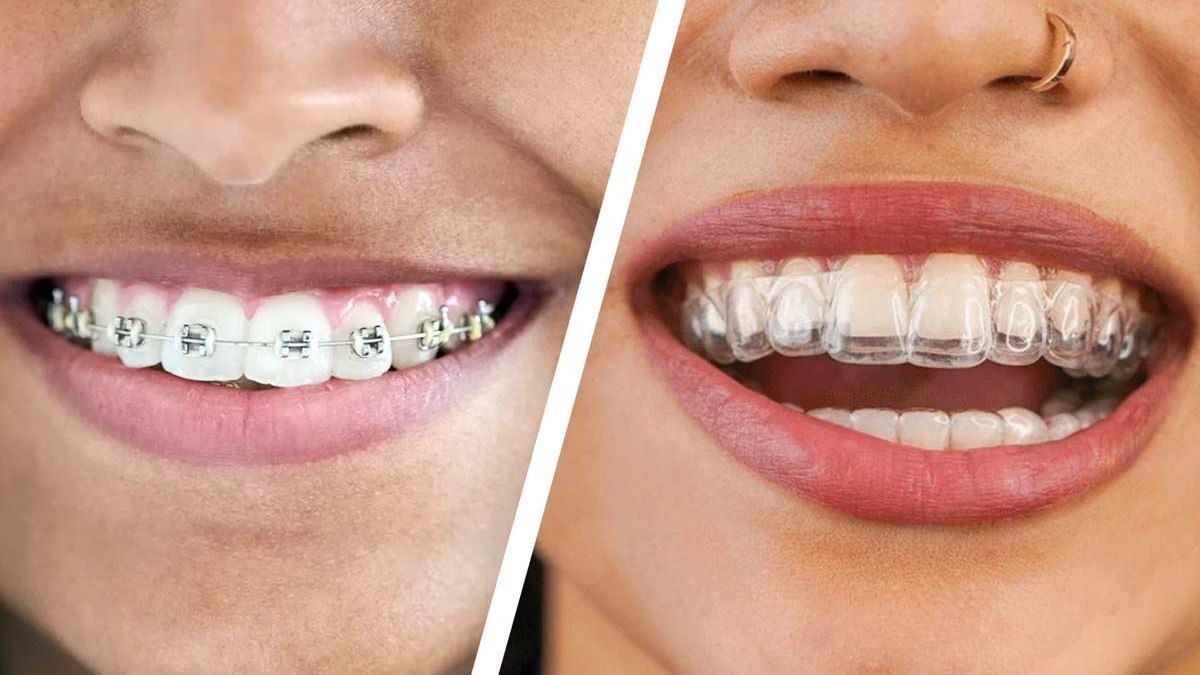
Braces vs. Aligners: Which One Is Right for You?
Braces and clear aligners both straighten teeth — but they work differently, suit different cases, and come with very different day-to-day experiences. The wrong choice doesn't just cost money; it can mean a longer treatment, poorer results, or relapse. This guide is written for patients in Gurugram who are ready to start orthodontic treatment and want an honest, clinical breakdown of what each option can and cannot do — before they sit down with an orthodontist.
How Each Treatment Actually Works
Traditional braces — metal or ceramic — use brackets bonded directly to each tooth, connected by an archwire that is periodically tightened. The continuous, controlled pressure moves teeth gradually into alignment. Because they are fixed to the teeth 24 hours a day, braces work whether or not the patient remembers to wear them.
Clear aligners are a series of custom-made, removable plastic trays — each slightly different from the last — that you swap out roughly every one to two weeks. Each tray shifts teeth a fraction of a millimetre closer to the final position. The trays must be worn 20–22 hours per day for results to be on track. Compliance is the single biggest variable in aligner treatment; braces remove that variable entirely.
Effectiveness: What Each Can and Cannot Fix
Braces remain a common option for complex orthodontic correction. They handle severe crowding, significant bite problems (overbite, underbite, crossbite, open bite), rotations, and vertical tooth movement with a high degree of clinical control. If your case is complicated, braces may offer more predictable control after clinical assessment.
Clear aligners have improved significantly over the last five years and now handle a wide range of mild-to-moderate alignment issues very effectively — spacing, mild crowding, and some bite corrections. They are a genuine option for many adult patients with straightforward cases. For severe skeletal issues or cases requiring significant tooth torque, braces remain the more predictable treatment.
The most important step is a proper clinical assessment before either treatment begins. At Marwaha Dental Clinic, Dr. Divya Marwaha evaluates your X-rays, bite, and tooth positions before recommending a treatment path — not the other way around.
Comfort and Daily Life: The Real Differences
| Factor | Metal / Ceramic Braces | Clear Aligners |
|---|---|---|
| Visibility | Metal: clearly visible; Ceramic: tooth-coloured, less obvious | Nearly invisible in daily life |
| Comfort | Initial soreness after tightening; brackets can irritate cheeks | Mild pressure when switching trays; no brackets or wires |
| Eating restrictions | Avoid sticky, hard, and chewy foods throughout treatment | Remove trays to eat — no food restrictions at all |
| Oral hygiene | More effort required; flossing around wires is difficult | Remove trays to brush and floss normally |
| Compliance required | None — fixed to teeth | Must wear 20–22 hrs/day; results suffer if not followed |
| Clinic visits | Every 4–6 weeks for tightening | Every 6–10 weeks for monitoring |
| Sports / instruments | Mouth guard recommended; wind instruments may be affected | Remove trays for contact sports; no effect on instruments |
Treatment Duration: How Long Will It Take?
Braces typically require 18–30 months depending on the complexity of your case. More complex bite corrections or severe crowding sit toward the longer end of that range. Simpler alignment cases can be resolved in 12–18 months. The timeline is largely set by the biology of tooth movement — it cannot be meaningfully rushed without risking root damage.
Clear aligners for mild-to-moderate cases often complete in 9–18 months. Some straightforward spacing or crowding cases move faster — 6–9 months is achievable for genuinely simple presentations. However, if a patient is not wearing the trays consistently, the effective treatment time stretches well beyond any estimate. At Marwaha Dental Clinic, treatment timelines are discussed honestly at the assessment stage — not adjusted optimistically to make a treatment option sound more appealing.
Types of Braces Available in Gurugram
Patients in Gurugram have access to four main orthodontic options, each suited to different needs and aesthetic priorities.
- Metal Braces — stainless steel brackets and wires; the most reliable option for complex cases; completely effective regardless of patient compliance with diet or habits
- Ceramic Braces — tooth-coloured brackets that blend with enamel; same clinical effectiveness as metal; a strong middle-ground for adults who want discreet treatment without full aligner commitment
- Clear Aligners (Invisalign and Indian-brand alternatives) — removable transparent trays; usually suited for mild-to-moderate alignment issues in compliant adult patients; the preferred choice for professionals who prioritise aesthetics during treatment
- Lingual Braces — fixed braces bonded to the inside surface of the teeth; completely invisible from the front; available on assessment for patients with specific requirements
What Does Orthodontic Treatment Cost?
Orthodontic treatment is not a fixed-price service — and any clinic quoting you a number before examining your case is not giving you a number you can rely on. The actual cost depends on how complex your bite and alignment issues are, how long treatment will take, which type of braces or aligner system is clinically appropriate for your case, and the materials used.
At Marwaha Dental Clinic, Dr. Divya Marwaha provides a complete treatment plan — including timeline, treatment type, and exact cost — only after a proper clinical assessment of your X-rays, bite, and tooth positions. Book a consultation at either our DLF Phase 2 or Sector 39 clinic to get a plan built around your actual case, not a generic estimate.
Choosing the Right Treatment for You
There is no universally correct answer between braces and aligners. The right choice depends on the clinical complexity of your case, your lifestyle and aesthetic priorities, and your ability to comply with aligner wear requirements.
- Choose braces if you have significant crowding, bite misalignment, rotations, or a teenager who may struggle with removable-tray compliance — metal or ceramic depending on your aesthetic preference
- Choose clear aligners if you are an adult professional with mild-to-moderate alignment concerns, you can commit to wearing the trays 20–22 hours a day, and aesthetics during treatment are a priority
- Choose ceramic braces if you want clinical effectiveness equivalent to metal braces with improved aesthetics and without full aligner commitment
- Seek specialist assessment first — some cases that appear simple are clinically complex, and some that patients assume require braces can be handled very well with aligners
Why Orthodontic Expertise Matters
Dr. Divya Marwaha at Marwaha Dental Clinic holds an MDS, is a Gold Medalist, and brings 25+ years of clinical experience including senior tenure at AIIMS — one of India's most rigorous training environments. Orthodontic treatment is a long-term commitment. The doctor planning your case on day one should be the doctor seeing it through to the end, not a rotating associate at a franchise chain.
At Marwaha Dental Clinic, patients receive honest guidance on which treatment is the better clinical fit for their case — not whichever option is easier to sell. The clinic has operated continuously in Gurugram since 2004, with two locations — DLF Phase 2 (opposite Sahara Mall) and Sector 39 (near Medanta Hospital) — serving patients across Golf Course Road, Sushant Lok, and Sectors 38–45.
Retainers After Treatment: The Step Most Patients Underestimate
Whether you choose braces or aligners, teeth will relapse — move back toward their original positions — if retainers are not worn consistently after treatment ends. This is not a failure of treatment; it is the biology of teeth in a living jaw. Retainer compliance in the first 12 months after treatment ends is as important as the treatment itself.
At Marwaha Dental Clinic, retainer provision and follow-up care are discussed before treatment begins — not handed to you as an afterthought at the final appointment. Both fixed (bonded) and removable retainer options are available depending on your case requirements.
Frequently Asked Questions — Braces & Aligners in Gurugram
Are clear aligners as effective as braces?
For mild-to-moderate cases in compliant adult patients, clear aligners can achieve results comparable to braces. For complex crowding, significant bite correction, or rotations, metal or ceramic braces remain clinically more reliable. The only way to know which is right for your case is a proper orthodontic assessment — not a self-assessment based on photos.
How much do braces or aligners cost in Gurugram?
The cost of orthodontic treatment depends entirely on your case — the complexity of alignment issues, the treatment type recommended, and how long treatment will take. At Marwaha Dental Clinic, Dr. Divya Marwaha shares a complete treatment plan with exact pricing only after examining your X-rays and bite in person. Call +91-9650298009 to book your assessment.
Can adults get braces in Gurugram, or are aligners the only option for grown-ups?
Adults can absolutely get braces — ceramic braces in particular are very popular among adult professionals who want effective treatment without the visibility of metal. Clear aligners are equally suitable. The choice depends on your clinical case and lifestyle, not your age. A significant proportion of orthodontic patients at Marwaha Dental Clinic are working adults.
How long do I need to wear clear aligners each day?
A minimum of 20–22 hours per day. Trays should only be removed for eating, drinking anything other than water, brushing, and flossing. Patients who wear aligners for less than 20 hours per day will see their treatment timeline extend — sometimes significantly. If consistent compliance is not realistic for your lifestyle, braces are the more dependable option.
Which orthodontic clinic near Medanta Hospital, Gurugram offers braces and aligners?
Marwaha Dental Clinic Sector 39 at 395 P, Sector 39, Gurugram — near Medanta Hospital — provides metal braces, ceramic braces, and clear aligner treatment under Dr. Divya Marwaha (MDS, Gold Medalist, Ex-AIIMS, 25+ years). Call +91-9650298009 to book an orthodontic assessment.
Do teeth shift back after braces or aligners?
Yes — without retainers, teeth will gradually return toward their original positions. This is true of both braces and aligner treatment. At Marwaha Dental Clinic, retainer options (fixed and removable) are part of every orthodontic treatment plan, not an add-on afterthought.
Book An Orthodontic Assessment
Message the clinic on WhatsApp during clinic hours
Book via WhatsAppTimings: Mon-Sat: 10AM-8PM