
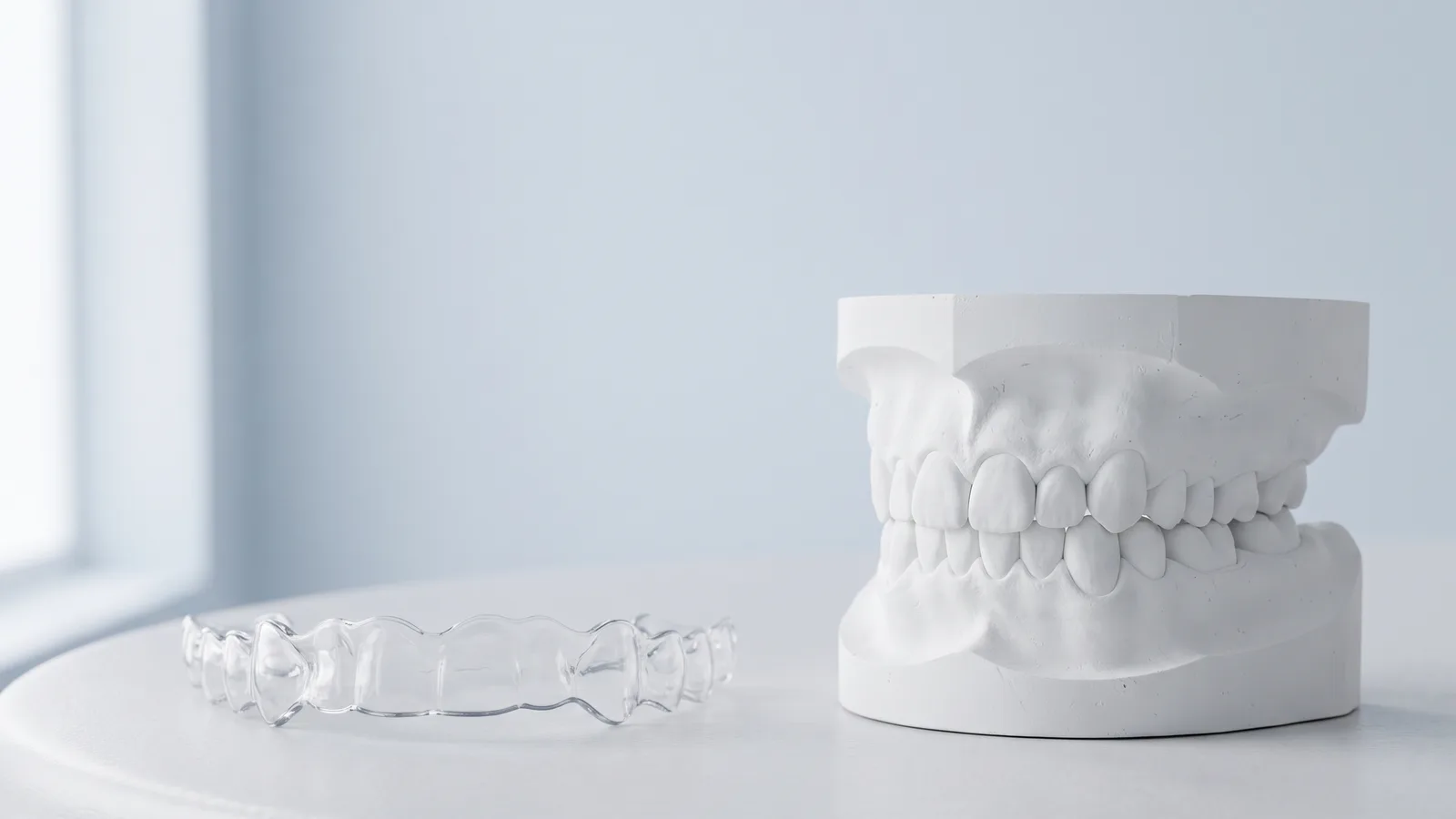
AI-generated image.
Night Guard for Grinding or Jaw Pain: What Is the Difference?
A night guard for grinding and an appliance considered for jaw pain can look almost the same, but they answer different questions. A grinding guard is a tooth-protection device: it separates the upper and lower teeth to help protect them from wear or fracture, and it does not guarantee that grinding stops. An appliance considered for temporomandibular disorder (TMD, a problem of the jaw joints or chewing muscles) belongs to a separate care decision, and evidence that these appliances relieve TMD pain is limited. NIDCR: Bruxism · NIDCR: TMD.
What is a night guard for grinding meant to do?
Bruxism means grinding, clenching or gnashing the teeth, either asleep or awake. Severe bruxism can damage teeth or restorations (fillings, crowns and similar repairs) and can cause jaw pain or tiredness and headache, while mild cases may not need treatment. NIDCR: Bruxism.
When a dentist finds a reason to protect the teeth, a guard may be discussed. It sits between the upper and lower teeth so they do not rub directly on each other. A guard may reduce muscle activity (NIDCR: Bruxism), but it does not prove grinding has stopped and does not promise that teeth or restorations will stay undamaged. A dentist-made splint worn during sleep is aimed at wear and fracture protection. Leeds Teaching Hospitals: sleep splints and awake-clenching strategies.
Is a grinding guard the same as treatment for jaw pain?
No. TMD includes disorders of the jaw joints, the chewing muscles and associated headaches, but mouth, tooth, face and jaw pain can also have other causes. Diagnosis uses your history and an examination, with imaging when it is indicated, and other causes of facial pain must be considered. A guard chosen to protect teeth does not, by itself, identify why the jaw hurts or establish a TMD diagnosis. NIDCR: TMD.
The two problems can overlap, which is why people confuse them. Someone may grind at night and also have jaw pain, or have worn teeth with a jaw that feels fine. Treating them as one question can lead to the wrong expectation from a device.
How do the options compare?
The table sets the three common approaches side by side. It describes general purposes and limits, not what any individual needs.
| Approach | What it is for | What it does not do | Who may be assessed for it | What to ask |
|---|---|---|---|---|
| Grinding or tooth-protection guard | Separating the teeth during sleep to help protect them from grinding wear or fracture. NIDCR: Bruxism | Does not guarantee that grinding stops, and evidence that it eases TMD pain is limited. NIDCR: TMD | People whose dentist finds sleep grinding with tooth or restoration damage. | What is it protecting, how will fit and wear be reviewed, and what is the wear schedule? |
| Appliance considered for jaw (TMD) pain | One option a dentist or doctor may consider if self-care has not helped or a specific type of TMD is identified. NIDCR: TMD | Does not have strong evidence for relieving TMD pain, and should not permanently change the bite. | People with jaw joint or chewing muscle pain after assessment of other possible causes. | What is it meant to address, is it reversible, and how will its effect be reviewed? |
| Awareness and habit strategies | Reducing awake clenching and the load on the jaw, such as cutting back on gum chewing. NIDCR: Bruxism · NHS: Temporomandibular disorder | Does not protect teeth during sleep grinding. | People who notice daytime clenching or jaw strain. | Which habits matter for me, and when should I come back if nothing changes? |
When is an appliance considered for jaw pain, and what are its limits?
Many TMD symptoms improve without treatment, and painless jaw clicking usually does not need treatment. Conservative, reversible care is generally preferred before invasive treatment. If simple self-care does not help, or a specific type of TMD is identified, a dentist or doctor may recommend options such as physical therapy, behavioural care or an oral appliance. The benefit of oral appliances for TMD pain is uncertain. NIDCR: TMD.
Intraoral splints fit over the teeth and should not permanently alter the bite. Treatments that permanently change the teeth or bite should generally be avoided, so changing the bite, braces or extensive reconstruction should not be presented as a proven TMD cure. Tooth protection is a separate outcome from pain relief, which is why a guard that suits grinding is not automatically the answer to jaw pain. NIDCR: TMD.
What can you do about awake clenching and jaw strain?
Awake clenching is managed differently from sleep grinding. Awareness and behavioural strategies can help reduce it, and a night-time guard should not be assumed to deal with daytime habits. NIDCR: Bruxism · Leeds Teaching Hospitals: sleep splints and awake-clenching strategies.
For jaw strain during a painful flare, temporarily softer foods can reduce chewing demands, and reducing gum chewing and clenching can reduce jaw loading. These are temporary measures, not a diagnosis. NHS: Temporomandibular disorder. Stress, certain substances and some medicines can contribute to bruxism. NIDCR: Bruxism. If a medicine may be involved, speak to the prescriber before changing anything.
What should you ask a dentist about a guard or splint?
- Is the aim to protect teeth, ease jaw pain, or both, and what is the evidence for that aim?
- Is the device reversible, and will it change my bite?
- How will fit, wear and any change in symptoms be reviewed over time?
- Are there habit changes I should try alongside it?
- What should make me stop using it and come back?
Regular dental check-ups help the dentist spot signs of bruxism. NIDCR: Bruxism.
When should you see a dentist promptly, and when can you book routinely?
Seek urgent assessment if you cannot eat or drink because of jaw pain, or if jaw pain comes with visual symptoms or frequent, severe headaches. These can be signs of a serious problem that needs urgent treatment. Also ask for urgent assessment if your jaw locks or you cannot open your mouth fully. NHS: Temporomandibular disorder.
Stop and consult if a guard or other appliance causes pain. An appliance causing pain should be stopped and assessed. NIDCR: TMD.
A routine booking is reasonable for worn or chipped-looking teeth, morning jaw tiredness, a partner noticing grinding, or occasional jaw discomfort without the warning signs above.
Which assessment should you ask the clinic about?
Marwaha Dental Clinic describes separate teeth-grinding and TMJ consultation pathways. The grinding assessment considers sleep versus awake habits and tooth or restoration damage; the TMJ consultation considers symptoms, jaw movement and dental health. You can read more on the teeth-grinding assessment page, the jaw-pain assessment page, our guide to jaw pain, clicking and TMJ disorder and our page on worn and chipping teeth and bite assessment. These pages do not establish your diagnosis or confirm that a specific appliance is available or suitable for you.
If you are not sure which fits your concern, call +91-9818379780 or message the clinic on WhatsApp and ask. The clinic is at J-4/33, DLF Phase II, opposite Sahara Mall, Gurugram – 122002, open Monday to Saturday, 11 AM to 7 PM. See the DLF Phase 2 clinic page or the contact page.
Frequently Asked Questions
Do not decide this yourself. A guard chosen for tooth protection does not diagnose or treat jaw pain, and an appliance that causes pain should be stopped and assessed. Ask a dentist what the device is meant to do, whether it is reversible and how its effect will be reviewed before wearing one. NIDCR: TMD
It can help some people, but the evidence is limited. A splint worn during sleep can help with pain from grinding, while for TMD (jaw joint or chewing muscle problems) there is not a lot of evidence on whether oral appliances improve pain. Some people find soft splints make them clench more, which can worsen jaw pain. A guard also does not identify why your jaw hurts, so jaw pain needs its own assessment. See Leeds Teaching Hospitals · NIDCR: TMD.
No. Mild bruxism may not need treatment, and a guard is not automatically right for everyone. A dentist considers your symptoms and any damage to teeth or restorations before discussing options, and regular dental check-ups help the dentist spot signs of bruxism. NIDCR: Bruxism
Severe bruxism can cause jaw pain or tiredness and headache, but tired or painful jaws can also come from jaw joint or chewing muscle problems, or from causes unrelated to grinding. Your history and an examination help sort this out, so a guard alone should not be assumed to be the answer. NIDCR: Bruxism · NIDCR: TMD
Leeds Teaching Hospitals advises that a splint should be made by a dentist, and a splint that does not fit properly can cause problems with your teeth or gums. A dentist can also check whether a guard is the right step for you. See Leeds Teaching Hospitals.
Common types include a soft splint made from a slightly flexible material, like a thin sports gumshield; a stabilisation splint made from hard plastic, which helps it last longer; and a mandibular advancement device, which covers the top and bottom teeth and holds the lower jaw slightly forward and may be recommended for people with suspected or confirmed obstructive sleep apnoea. Some people find soft splints make them clench more or wear through quickly. Ask the dentist which type is being suggested and why. See Leeds Teaching Hospitals.
Stop using an appliance that causes pain and contact your dentist. A splint that does not fit properly can also cause problems with the teeth or gums, so have the fit checked by your dentist. See NIDCR: TMD · Leeds Teaching Hospitals.
Not necessarily. Leeds Teaching Hospitals says sleep grinding is not necessarily a problem and does not damage the jaw muscles or joints, but it can worsen existing jaw joint or muscle (TMD) symptoms, and it can wear or break teeth. Jaw pain still deserves an assessment, because it can have other causes. See Leeds Teaching Hospitals.