
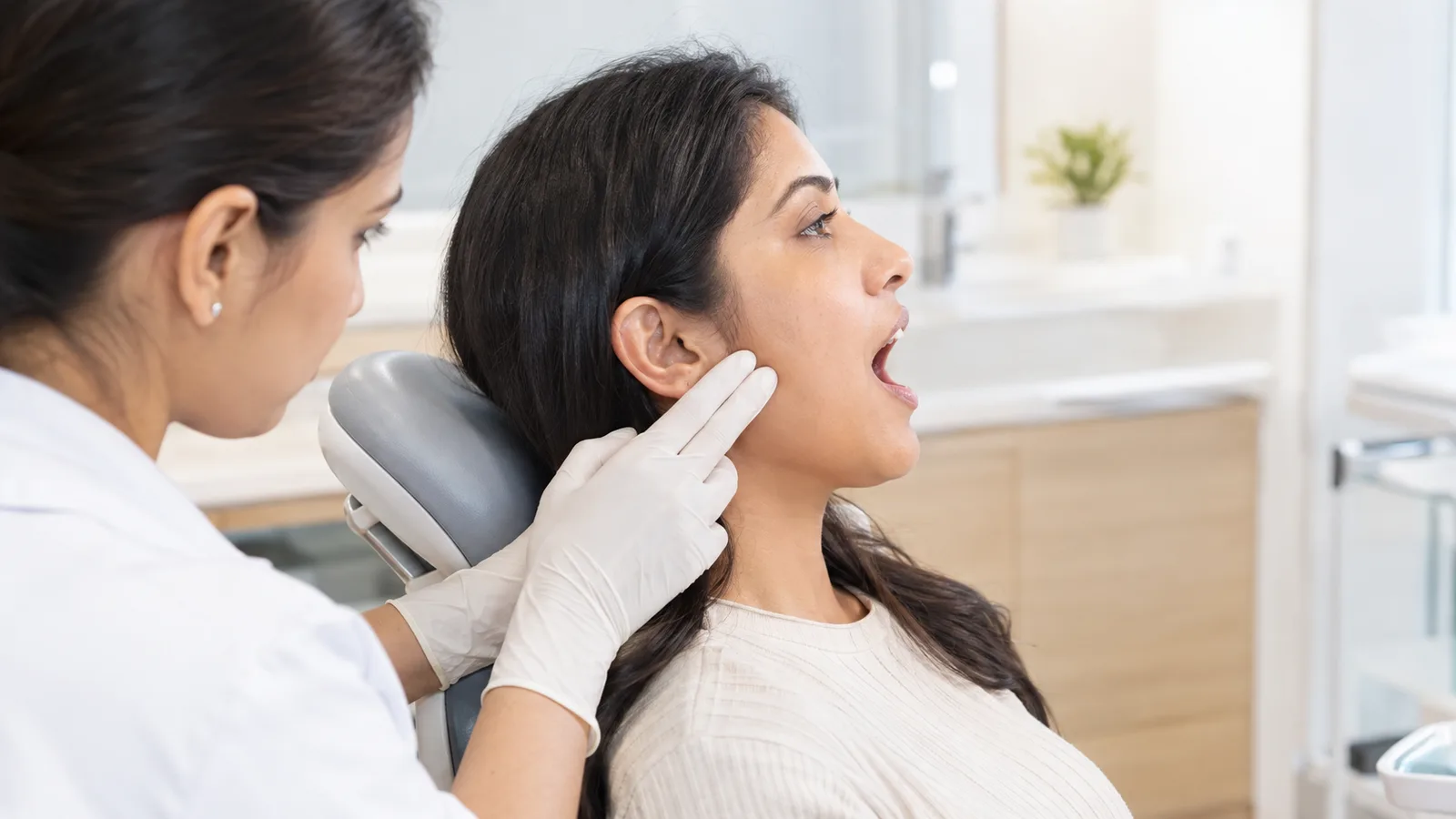
AI-generated image.
Which Doctor Should You See for TMJ or Jaw Pain in Gurgaon?
For most jaw pain, clicking or difficulty opening the mouth, a dentist or a doctor is a sensible first stop. Either can take your history, examine the jaw and consider other causes of facial pain. A physiotherapist, a psychologist or a specialist may become part of your care later, depending on what the assessment finds. The exception is jaw pain that comes with chest pain, breathlessness, vision problems or an inability to eat or drink: that needs urgent medical help, not a routine dental booking. NIDCR: TMD · NHS: TMD.
First, rule out jaw pain that needs urgent help
Jaw pain is usually a problem of the jaw joints, the chewing muscles or the teeth. Occasionally it is a sign of something that cannot wait:
- Chest pain that spreads to the arm, neck or jaw, especially a crushing or squeezing feeling, can be a heart attack. Call emergency services straight away (112 in India) and do not drive yourself to hospital. NHS: Heart attack.
- Jaw pain while eating or talking together with pain or tenderness at the temples or scalp, or vision problems such as double vision, can be signs of giant cell arteritis, an inflammation of blood vessels that needs urgent medical assessment. NHS: Giant cell arteritis.
- Being unable to eat or drink, or having frequent, severe headaches, needs urgent assessment. NHS: TMD.
If none of these apply, the next step is usually an assessment of the jaw. Get seen promptly if your jaw locks or you cannot open your mouth fully. NHS: TMD.
Who usually assesses TMJ and jaw pain?
TMJ disorder, also called TMD (temporomandibular disorder), is a group of problems affecting the jaw joints and the muscles that move the jaw. The US National Institute of Dental and Craniofacial Research (NIDCR) advises consulting a dentist or a doctor, who will note your symptoms and take a detailed medical history. There is no single standard test for TMD, so the examination matters, and imaging such as an X-ray or MRI may be recommended when it is needed. NIDCR: TMD.
A dentist is often a practical first choice when the teeth may be involved: pain on biting, worn or chipped teeth, a recent dental treatment, or a partner noticing night-time grinding. The NHS lists a dentist as one of the professionals a GP may suggest when teeth grinding might be an issue. NHS: TMD. A doctor is a sensible first choice when jaw pain comes with any of the warning signs above, or when you are unsure what is causing it.
Which professional does what?
| Professional | When they may be involved | What they may do |
|---|---|---|
| Dentist | Jaw pain, clicking or limited opening, especially with tooth wear, grinding, biting pain or recent dental work | History, jaw and muscle examination, tooth and bite check, X-rays when indicated, advice on conservative care and review |
| Doctor (GP or physician) | Jaw pain with any of the urgent warning signs, or when the cause is unclear | Checks for other causes, may suggest stronger painkillers, relaxation techniques or sleep advice, and refers when needed |
| Physiotherapist | Ongoing muscle or movement problems after assessment | Advice on jaw exercises and massage, guided movement care |
| Psychologist | When stress or anxiety is making the pain worse | Behavioural approaches such as cognitive behavioural therapy or biofeedback |
| Orofacial pain or joint specialist | Pain that has not improved with simpler care, or before any surgery or permanent treatment | Second opinion, further assessment, and discussion of options such as injections or surgery |
Sources for the table: NHS: TMD · NIDCR: TMD.
What is an orofacial pain specialist?
Orofacial pain is an area of dentistry that focuses on the diagnosis and management of pain disorders of the jaw, mouth, face, head and neck. In the United States it was recognised as a dental specialty in 2020. American Academy of Orofacial Pain. NIDCR suggests considering a second opinion from an orofacial pain specialist where possible, particularly before any treatment that cannot be undone. NIDCR: TMD.
You do not usually need to start with a specialist. Many TMD problems last only a short time and settle on their own, and the NHS describes TMD as not usually serious. NIDCR: TMD · NHS: TMD. A specialist opinion becomes more useful when pain persists despite simple care, when the diagnosis is uncertain, or when surgery or another permanent treatment has been suggested.
What should a good first assessment include?
Whoever you see first, a careful assessment usually covers:
- When the pain started, where it is, and what makes it better or worse
- Clicking, locking or difficulty opening or closing the mouth
- Grinding or clenching, sleep, stress and recent dental treatment
- An examination of jaw movement, the jaw joints and the chewing muscles
- A check of the teeth, because tooth problems can cause similar pain
- Whether imaging is actually needed, rather than routine scans for everyone
Our guide to jaw pain, clicking and headaches lists what to note before the appointment, so you can describe your symptoms clearly.
Questions to ask before agreeing to treatment
Experts recommend conservative treatments first and avoiding treatments that permanently change the jaw joints, and there is insufficient evidence that treatments which permanently alter the bite, such as grinding down teeth or orthodontics to change the bite, treat TMD. NIDCR: TMD. Useful questions include:
- What do you think is causing my pain: the joint, the muscles, the teeth or something else?
- Is the treatment you suggest reversible?
- How will we know whether it is working, and when will we review it?
- If surgery is suggested: why, what other options exist, how will it help and what are the risks? NIDCR notes there are no long-term studies on the safety of open surgery for TMD. NIDCR: TMD.
For a closer look at appliances, read night guards for grinding versus jaw pain.
What can you do while waiting for an appointment?
The NHS suggests simple measures: eat soft food such as pasta, omelettes and soup; hold an ice pack or a heat pack wrapped in a tea towel to the jaw, whichever feels better; and avoid chewing gum or pen tops, biting your nails, clenching your teeth and yawning too wide. NHS: TMD. If pain is getting worse, or any of the urgent signs above appear, do not wait for the routine booking.
TMJ and jaw pain assessment in DLF Phase 2, Gurugram
At Marwaha Dental Clinic, jaw pain is assessed by Dr. Divya Marwaha, the clinic's founder and a dental surgeon with 25+ years of clinical practice. Her profile lists a BDS (Gold Medalist), advanced training at AIIMS, New Delhi, and a postgraduate diploma in oral implantology and surgery from Germany. The consultation looks at your symptoms, jaw movement and dental health before any care is discussed. Read more about TMJ treatment in Gurgaon, the teeth-grinding assessment and Dr. Divya Marwaha's profile.
To book, call +91-9818379780 or message the clinic on WhatsApp. The clinic is at J-4/33, DLF Phase II, opposite Sahara Mall, Gurugram – 122002, open Monday to Saturday, 11 AM to 7 PM. See the DLF Phase 2 clinic page or the contact page.
Frequently Asked Questions
Either can start the assessment. A dentist is a practical first choice when teeth, grinding, biting pain or recent dental work may be involved; a doctor is a sensible choice when you are unsure of the cause or have any of the urgent warning signs. Chest pain spreading to the jaw, vision problems or being unable to eat or drink needs urgent medical help. See NIDCR: TMD · NHS: Heart attack.
Orofacial pain is an area of dentistry focused on pain disorders of the jaw, mouth, face, head and neck, and it became a recognised dental specialty in the United States in 2020. NIDCR suggests a second opinion from an orofacial pain specialist where possible, especially before treatment that cannot be undone. Most people do not need to start with a specialist. See American Academy of Orofacial Pain · NIDCR: TMD.
Not always. There is no single standard test for TMD, so your dentist or doctor will take a detailed history and examine your head, neck, face and jaw. Imaging such as an X-ray or MRI may be recommended when the clinician needs more information. See NIDCR: TMD.
Yes, for some people. The NHS lists a physiotherapist for advice about jaw exercises and massage, and NIDCR includes physical therapy among nonsurgical treatments. It is usually considered after an assessment, if simple self-care has not helped. See NHS: TMD · NIDCR: TMD.
Yes. The NHS lists stress as a possible cause of TMD. The NHS lists a psychologist when stress and anxiety are making the pain worse, and NIDCR describes behavioural approaches, usually offered by a psychologist. See NHS: TMD · NIDCR: TMD.
Usually only after simpler care has not helped. The NHS says you may be referred to a specialist in joint problems to discuss options such as painkilling injections or surgery. NIDCR notes there are no long-term studies on the safety of open TMD surgery, and it is unclear whether botulinum toxin injections relieve TMD symptoms, so ask why it is suggested, what the alternatives are and what the risks are. See NHS: TMD · NIDCR: TMD.